Meet Sophie Tuke
Sophie Tuke lives in the Cotswolds, where she divides her time between writing, walking her dogs across fields that don’t belong to her and maintaining a fountain pen collection that has long since crossed the line from hobby into clinical condition. She writes exclusively in turquoise ink, mainly because it is pretty.
She has attended more country house weddings than is medically advisable, believes croquet is a blood sport in disguise and once played a version involving flaming balls that she is not entirely sure was legal. She holds strong views on scones (clotted cream first, then strawberry jam: this is not negotiable) and believes the perfect picnic requires, at minimum, a linen tablecloth and a view worth painting.
When not writing she can be found skiing, boating in the south of France or wandering the countryside in wellies. She reads voraciously: Wodehouse for the prose, Christie for the plotting and le Carré for the paranoia.
The Killer Wedding is her debut novel. She is already working on the sequel, in turquoise ink, with champagne at a responsible distance from the manuscript.
Hi, I'm Sophie, thanks for dropping by and finding out more about The Killer Wedding.
I wrote this book because I wanted to read it and nobody else had written it yet.
I've spent years at the kind of weddings where the seating plan causes more drama than most thrillers, where someone's uncle has said something unforgivable by the second course and where the best man's speech is either a masterpiece or a war crime. I've always thought: what if the real danger wasn't the speeches? What if someone was actually trying to kill the groom, and the bride was the most dangerous person in the room?
Henry Vaughn arrived in my head fully formed; dry, loyal, suspicious of everyone and completely incapable of not getting involved. I wrote the first chapter with a fountain pen (turquoise ink, always) in a notebook at my kitchen table and by the time Henry woke up in the Dower House with the hangover and the missing hours, I knew I was in trouble. The good kind.
The world of the book is one I know well. The houses, the rituals, the elaborate politeness that masks all manner of chaos; it's real, or at least it's only slightly exaggerated. The lobsters are invented. The ketchup snobbery is not.
If you enjoy The Killer Wedding, I'd be enormously grateful if you left a review. Henry Vaughn will return and next time, there's a christening to survive.
Sophie
(Written in turquoise ink, transcribed reluctantly onto a laptop)
Q and A
Where did the idea for A Wedding to Die For come from?
I've always loved the comedy of English upper-class life; the rituals, the rigid manners, the absolute chaos underneath the polished surface. And I've always thought weddings are where all of that is most gloriously on display. Everyone's on their best behaviour, and everyone's falling apart. I wanted to write a love story set in that world, but I also wanted real stakes, something more dangerous than a seating plan crisis. So I thought: what if someone was actually trying to kill the groom and nobody noticed because they were all too busy arguing about the seating plan?
You describe the book as "Four Weddings meets Wodehouse meets A Fish Called Wanda, with a touch of Bridgerton." That's quite a cocktail.
It is, and like most good cocktails, it shouldn't work but somehow does. The Wodehouse is in the prose (hopefully, I know that is a big stretch) that light, elaborate, building-to-a-punchline style where the English upper classes are both loveable and completely absurd. The Richard Curtis is in the heart, I wanted readers to genuinely care about James and Anastasia, to root for them the way you root for Hugh Grant fumbling through a confession of love. And the Fish Called Wanda is Viktor. Every good comedy needs a villain who takes himself far too seriously. Otto from Wanda is one of the great comic villains because he's genuinely dangerous but keeps being undone by his own grandiosity. Viktor is different, but the initial kernel came from him. Now he is meticulous, lethal, defeated by lobsters. As for Bridgerton, well who hasn’t fallen in love with the fantastic sets, locations and a window into a world that never was.
James is described as "not, in any conventional sense, a stupid man." How would you describe him?
He's the kindest person in the room and the last one to notice anything dangerous happening in it. I think of James as someone with enormous emotional intelligence and almost no situational awareness. He can read people beautifully, he knows what Anastasia needs before she does, he flies to Scotland at a moment's notice when a friend is grieving, he rewires an entire wedding overnight because he can see his bride is unhappy. But he cannot for the life of him tell that someone is trying to murder him. He just doesn't think the world works that way. And that optimism, that fundamental belief that people are good is what makes him worth saving. It's also what makes Anastasia fall in love with him. She's spent her whole life around people who calculate and manipulate and here's this man who is exactly what he appears to be. That's extraordinary to her. It's the most attractive thing she's ever encountered.
Anastasia is a former Ukrainian intelligence operative. How did you approach writing her?
Carefully. She's the character I thought about the longest. I didn't want her to be a cliché; not the femme fatale, not the damsel, not the ice-cold spy. She's someone who was recruited at sixteen, spent years in a world of deception and danger, and then walked away from all of it to build something real. When we meet her, she's running an AI startup, she's genuinely brilliant and she's trying very hard to be a normal person. But "normal" doesn't come naturally when you've spent your formative years learning to assess threats and memorise exit routes. The thing I love about her is that she falls for James not despite his ordinariness but because of it. He's safe. He's honest. He's incapable of having a hidden agenda. For a woman who has spent her life surrounded by people with hidden agendas, that's intoxicating.
The book is narrated by Henry, the best man. Why not James or Anastasia?
Because James doesn't know he's in danger, so he can't tell a thriller. And Anastasia knows too much, so she'd give away the plot. Henry is the perfect narrator because he's in the middle; observant, suspicious, loyal, slightly exhausted. He can see that something isn't quite right about Viktor, he can see that Anastasia is more than she seems, but he doesn't have the full picture until the end. He's also dry and sardonic in a way that lets the prose have fun. Henry would never describe something as "magnificent" without adding a qualifier. His version of a compliment is "it was eventful." I love writing him and find slipping into his voice a real treat.
The assassination attempts are foiled by things like lobsters, ketchup snobbery, and fireworks. How did you come up with those?
The rule I set myself was that every failed attempt had to be foiled by something completely organic to the world of the book; never by coincidence or luck, but by the natural chaos of these people being themselves. Elizabeth confiscates the poisoned ketchup because she's a snob. Freddie fills the rigged hot tub with lobsters because he thinks it's funny. James orders fireworks to make Anastasia happy and accidentally destroys a weaponised drone. The comedy comes from the fact that Viktor's plans are genuinely good; professional, meticulous, lethal and they're defeated by people who have no idea what they're doing. It's the English talent for bumbling through crises. We've been doing it for centuries.
Granny is a fan favourite. Tell us about her.
Granny Cordelia is, in some ways, the most dangerous person in the book. She was a proper Cold War spy, "something in the Foreign Office" that took her to Moscow and Berlin and places that didn't officially exist. She's retired now, theoretically, but she's the only person who sees Anastasia clearly from the start. She recognises a fellow professional. There's a moment where she asks Anastasia a pointed question in flawless Russian, and you can feel the temperature in the room drop. But she's also the person who ultimately decides to trust Anastasia, because she can see the love is real. Granny's loyalty is to James, always, but her respect goes to competence. And Anastasia is deeply competent. I think of Granny as the person I'd most like to have dinner with from the whole book. She'd be terrifying and wonderful in equal measure, and she'd have the best stories.
The women in the book are all strong characters while the men are, as you've put it, "buffoons." Was that deliberate?
Completely deliberate. The men in this world are lovely; kind, loyal, enthusiastic, generous, but they are absolutely useless when it comes to anything practical. James can't pack a suitcase. Freddie's solution to every problem involves either alcohol or fire. Archie can't remember his own girlfriend's name reliably. The women, meanwhile, are running everything. Camilla has Freddie on a training programme. Sophie has a Cambridge First and is building a sustainable farming business. Anastasia is running a tech startup while secretly protecting her fiancé from assassination. Elizabeth, for all her rigidity, is the only person who actually made the original wedding plans work. Even the secondary women; the hen do crowd are competent, funny, and formidable. The boys provide the chaos. The women provide the structure. And Granny, of course, provides both.
Viktor escapes. Does that mean there's a sequel?
Viktor fell into the lake. No body was found. I'll leave you to draw your own conclusions. But I will say this: Granny has stories of her own that haven't been told yet. And James remains, as ever, magnificently oblivious. There's more to come.
What do you want readers to feel when they finish the book?
Happy. I want them to feel the way you feel at the end of a really good wedding; slightly drunk, slightly emotional, full of warmth for people you've spent the day with. I want them to have laughed out loud at least three times. I want them to have genuinely cared about James and Anastasia. And I want them to feel that particular satisfaction of a love story where you know, absolutely know, that these two people are going to be all right. The world is full of dark, complicated, morally grey fiction and I love a lot of it. But sometimes you want a book that believes in kindness, that thinks love is worth fighting for and that proves the villain can be defeated by good people doing ridiculous things. That's what this book is. It's a love story. Believe it or not.
What are you reading at the moment?
I'm always reading about four things at once something funny, something thrilling, something smart, and something I probably should have read years ago. I'm a lifelong Wodehouse devotee. Marian Keyes makes me laugh and cry in the same chapter, which I think is the hardest trick in writing. I love Richard Osman's Thursday Murder Club books for the way they balance warmth and cleverness. And I keep going back to John le Carré, not for the tone, mine is rather different but for the craft. Nobody built a world like le Carré.
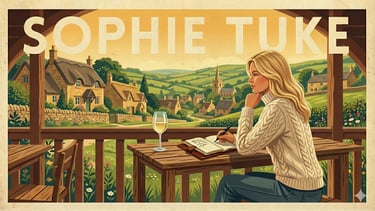
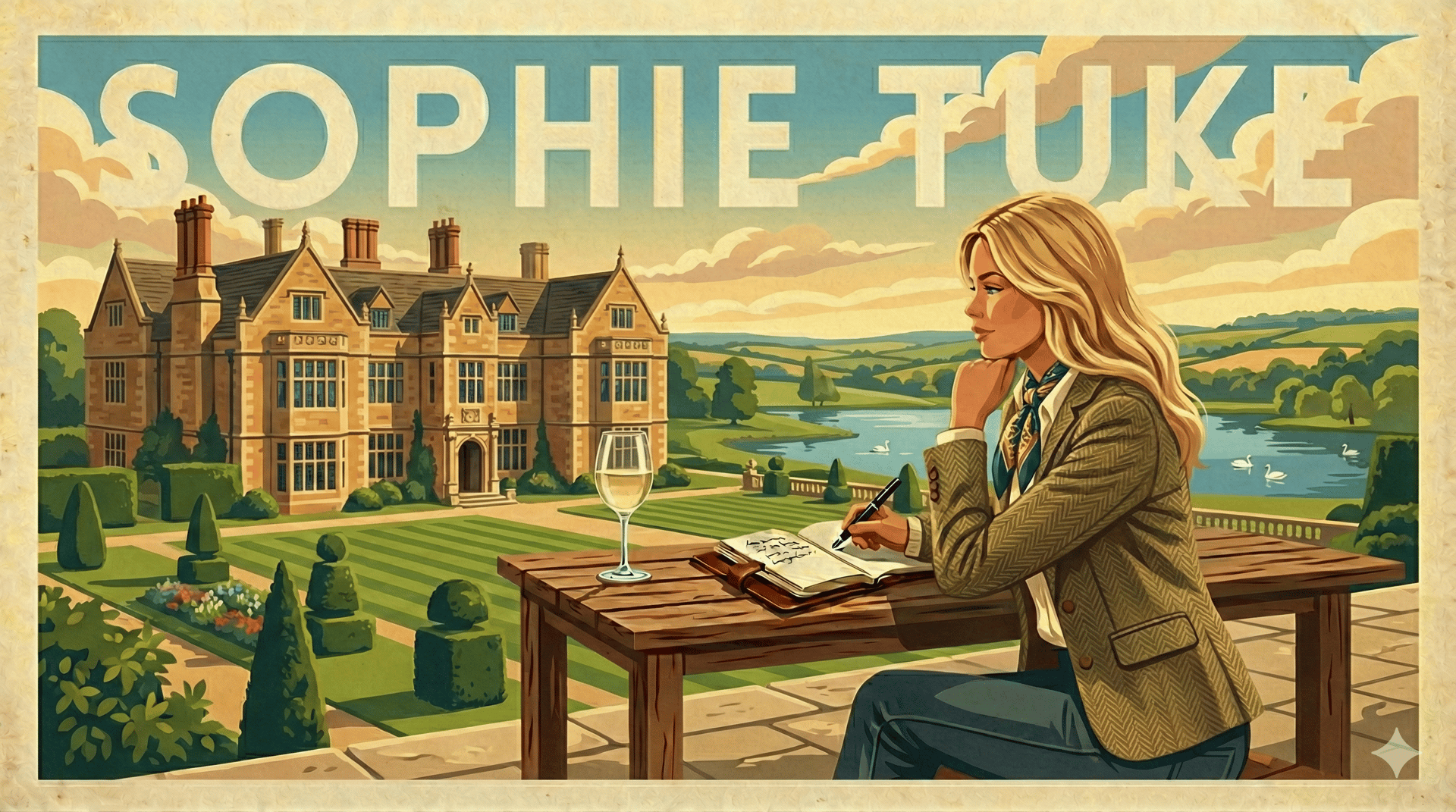
There are no photos of you on the website. Why illustrated portraits instead?
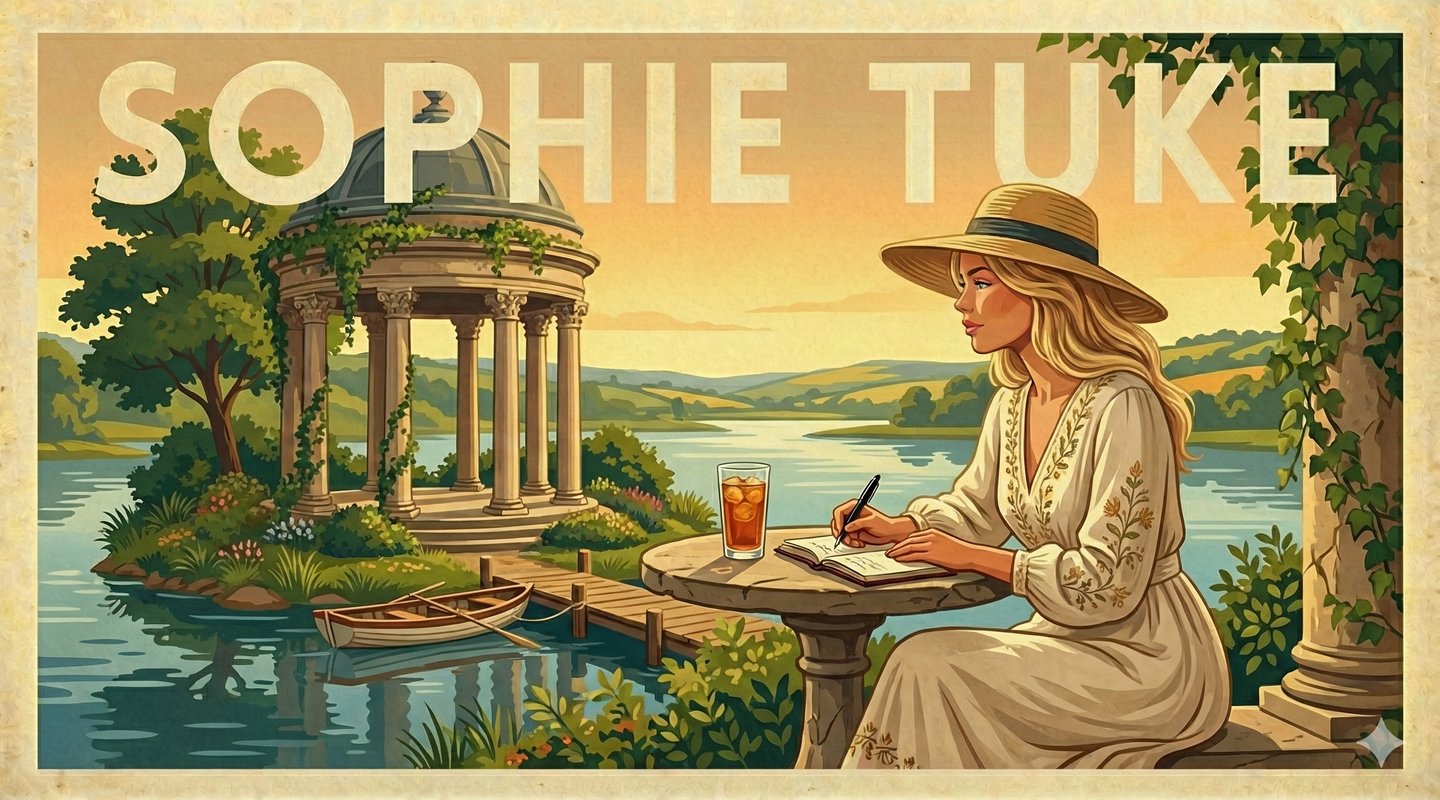
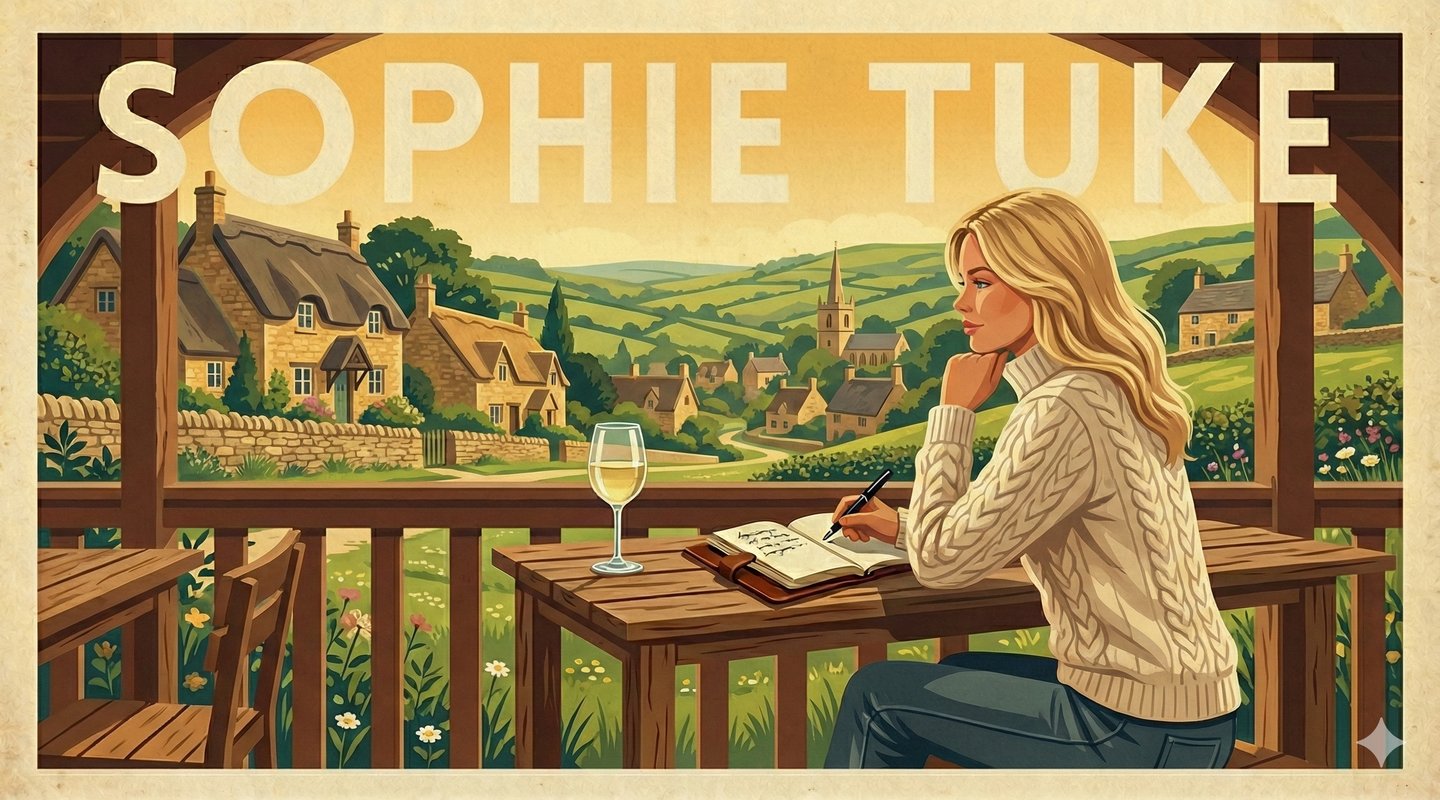
Because this whole world started in my imagination and I wanted the website to feel like stepping inside it. The vintage travel poster, style those bold colours, the warmth, the slight feeling of a story being told, that's what it feels like inside my head when I'm writing. It's how I see the characters, how I see the locations, how I see myself sitting at a desk surrounded by notes about lobster logistics and balloon physics and whether you can actually drive in ski boots.
A photo is a photo. It tells you what someone looks like on a Tuesday afternoon. But this is my story, my world and I thought why not let it spill over into everything? Why not let the website feel like the book? The characters are illustrated. The scenes are illustrated. So why shouldn't I be? I'm part of this world too. I built it. I might as well live in it.
Besides, there's something rather fitting about an author who writes about spies and secrets and people who aren't quite what they seem choosing not to show her face. A little mystery never hurt anyone. Well, it hurt Viktor. But he deserved it. And before you ask it, no I am not a spy myself, promise...
Which parts made you laugh the most while writing?
The Double and the stag do. I was gone. Properly gone, laughing at my own writing, which is either a very good sign or a very bad one.
The Double: the ski-sea challenge, just kept escalating in a way I hadn't planned. I knew James had to drive down a mountain in ski boots, but I didn't know until I was writing it that the car would start dying, or that he'd end up clomping down a harbour road sounding like "a horse with a particularly aggressive case of hooves," or that he'd take a running dive off the jetty in a full ski suit and bob around like an inflatable because of that ridiculous puffer jacket. And then Maurice, just watching all of this unfold with magnificent indifference and a Gauloise. "You did not win." I think I wrote that line and had to stop for five minutes.
The stag do was worse. Or better, depending on your perspective. The fondue bath was supposed to be a brief moment, a bit of silliness before the skiing. But then the ski poles became jousting equipment and someone started drinking wine from a boot, and James got thrown bodily into a copper vessel the size of a sarcophagus and emerged covered head to toe in melted cheese, and I thought: well, he can't ski in that, can he? So out came the fuchsia lederhosen. I didn't plan the lederhosen. Henry had clearly been carrying them around waiting for exactly this moment, and I just had to write it down. Then Archie ended up being rescued by a nine-year-old on the learner slope, and Rupert lost a race to a seventy-year-old Frenchman and insisted it was unfair because the man had "decades of practice," and by that point I was crying laughing at my own desk.
The thing about comedy is you can't force it. The best moments came from knowing the characters so well that I could just put them in a situation and watch what happened. Freddie will always choose the most inadvisable option available. James will always commit fully to something stupid once his competence has been questioned. Maurice will always shrug. Once you know that, the scenes almost write themselves. You just have to keep up.
Finally — what's one thing readers won't expect about the book?
How romantic it is. People hear "assassination attempts at a wedding" and expect farce or thriller. And there is comedy, and there is danger. But at its heart, this is a love story about two people who shouldn't work together and absolutely do. The scene I'm proudest of isn't a failed murder attempt, it's James and Anastasia eating fish and chips by the Thames, and her telling him she's not used to feeling safe, and him saying, "There's no catch. I'm exactly what I seem to be." That's the book, really. Underneath all the lobsters and fireworks and exploding balloons, it's about the extraordinary power of someone who is simply, genuinely, good.
Get in touch
Use the form if you want to say hello
Join
Get sneak peeks, updates, behind-the-scenes nonsense and the occasional lobster.
Newsletter
© 2026. All rights reserved.