My Books
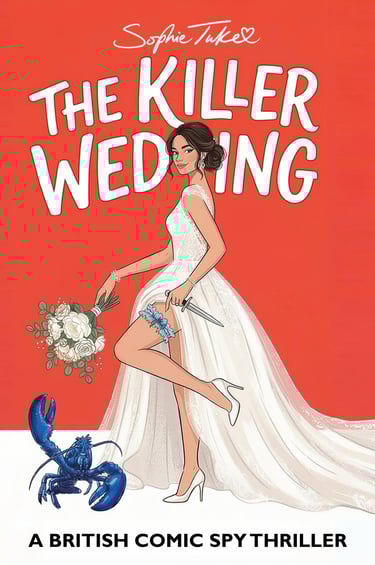
The Killer Wedding
Get your new favourite British comic spy action thriller! It's a British, romantic comedy thriller in the style of Four weddings and a funeral, with a touch of A fish called Wanda and some Bridgeton for the posh bits. Love Knives out of Richard Osmand and Slough house, then this is for you. Below is a free sample to give it a go!
Chapter One: A Bleary-Eyed Beginning
I have, in my time woken up in some fairly compromising situations.
There was the morning after Freddie’s twentieth, which found me in a punt on the Cherwell with no memory of how I’d got there and a traffic cone I’d apparently named Boris. The cone and I had, according to witnesses, conducted a lengthy conversation about the state of British politics before I passed out with my head on its orange shoulder. I kept Boris for three years afterwards, displayed on my mantelpiece as a reminder of the dangers of mixing champagne with Pimm’s and whatever Freddie had in that unlabelled bottle he claimed was ‘a family recipe.’
There was the incident in Reykjavik that I prefer not to discuss in detail, except to say that it involved a sauna, a profound misunderstanding about local customs and a junior minister from a Scandinavian country I had better not name. My girlfriend at the time was not pleased. The junior minister, last I heard, had been promoted.
And there was, of course, the fateful evening of James’s twenty-first birthday, which ended with me, a string quartet and the Dean of Christ Church in circumstances that still make me wince when I pass the college gates. The Dean has since retired. The string quartet broke up acrimoniously. I still receive a Christmas card from the cellist, which I have never been entirely sure how to interpret.
But none of those mornings, not even Reykjavik, prepared me for waking up in the Dower House at Hartington Hall on the morning after James Ashworth-Pemberton’s wedding.
I opened one eye, big mistake. The light streaming through the eighteenth-century windows was doing something violent and unnecessary to my cerebral cortex, as if someone had decided to conduct a full investigation of my neural pathways using nothing but photons and malice. I closed the eye again and attempted to take stock of my situation through other senses.
I was, as far as I could determine, horizontal. This was good, horizontal suggested a surface beneath me, a sofa, probably, from the texture against my cheek. Surfaces suggested stability and stability suggested that whatever had happened last night, I had at least managed to end it in a position compatible with continued existence.
I was also, somewhat surprisingly, still wearing my morning suit. The jacket had migrated to somewhere around my knees, bunched up in a way that suggested a significant lack of respect to my tailor. The waistcoat had fared better geographically (it was covering my eyes) but worse structurally: several buttons appeared to be missing and there was a stain on the front that I sincerely hoped was champagne.
From somewhere in the house came the sound of bagpipes.
This required explanation. Hartington Hall was in the Cotswolds, not the Highlands. And while Uncle Peregrine was known for his eccentricities (the rare chickens, the antique firearms and the persistent belief that London had become ‘uninhabitable’ sometime around 1987), I was fairly certain bagpipes had never featured among them.
The sound stopped, started again and then thankfully stopped for good.
Someone was clearly attempting to play the bagpipes without the faintest idea how to do so.
I removed the waistcoat from my eyes and surveyed the room.
The Dower House drawing room looked like the aftermath of a strangely festive apocalypse. Champagne bottles formed a small forest on the family’s Hepplewhite sideboard. Someone had attempted to arrange the empties in a pyramid, lost patience or balance halfway through and left them in a formation that suggested both ambition and defeat at the same time.
A lobster and I do mean a single, living lobster, was making its way across the rather fine Persian carpet with the determined air of a creature that had seen things and was processing them slowly. It paused at the edge of my field of vision, antennae twitching and regarded me with what I could only interpret as weary solidarity.
Through the window, I could see the main house, Hartington Hall itself, a honey-coloured Georgian pile that had been in the Earl of Cuckmere’s family for two hundred years. The bunting, which had been so tastefully arranged yesterday under Elizabeth’s exacting supervision, now drooped from the portico like the moustache of a defeated general. Someone had placed a top hat on one of the stone lions. The other lion was wearing what appeared to be a feather boa.
On the lawn, the hot tub sat in solitary splendour. James had fought for years to install that hot tub. His mother had considered it vulgar, his uncle had been baffled by the concept and he had finally, triumphantly, got what he wanted, if only temporarily. It sat now on the terrace like a monument to his victory, though the water looked far from clean.
Beyond the hot tub, the Capability Brown lake glittered in the morning sun. There was something on the surface of the far end that I didn't look at too closely. Some things are better examined after coffee.
The temple folly on its small island was adorned with what I sincerely hoped was not Elizabeth Ashworth-Pemberton’s Hermès scarf.
I squinted, peered at it intently and unfortunately confirmed my fears.
It was.
God help us all, because no one else could when she found out.
I extracted myself from beneath a young lady’s arm and made my way to the window, stepping over a discarded shoe, around a sleeping figure and past a small table littered with the debris of some fairly advanced late-night cocktail experimentation.
But where are my manners? I haven’t introduced myself, but in my defence, I have a very senior hangover. My name is Henry Vaughn and I am James's best friend, despite, or perhaps because of the fact that we have almost nothing in common. He's wealthy, trusting and fundamentally decent. I'm none of those things, or at least not in the same proportions.
I work in Whitehall. I have, when pressed, described my role as 'administrative liaison in cross-departmental risk assessment,' which is technically true and has the additional virtue of causing people to change the subject immediately. I share an open-plan office with eleven colleagues, where we work on spreadsheets, several spreadsheets, actually. We have a kitchen on the third floor with a passive-aggressive note on the microwave about fish, which has been there since 2019 and which no one has ever removed because no one wants to admit they've been in the office long enough to remember when it appeared. It is not, by any anybody’s view, a glamorous existence.
What it is, is useful and I have spent eight years learning to notice things: the question that doesn't quite fit the conversation, the handshake that's a fraction too controlled, the smile that arrives a beat too late. All of which is useful when one’s best friend has catastrophically poor judgment in new acquaintances.
I've spent years looking out for James, steering him away from his own good nature and the people who would exploit it. It's just what friends do.
Or it's what I do and I've had rather more practice than most.
Which brings me to the present, the carnage that I found myself in and the headache that is ripping through my skull.
I reached the window and looked down.
James and Anastasia were crossing the drive, arm in arm, pulling suitcases behind them.
They were dressed for travel: he in that ridiculous linen blazer he insists is ‘continental’, but which makes him look like a minor character in a 1970s Italian film, she in something simple and elegant that would look like a bin bag on most women but which on her was breathtaking.
They were laughing, against all odds and in defiance of all reasonable expectations they were radiantly happy.
I watched them for a moment, these two people I had been worrying about. James, with his boundless trust, his generous heart and his complete inability to recognise danger when it was sitting across from him at dinner. Anastasia, with her careful smile and watchful eyes, with the gaps in her story that I had noticed but never been able to fill.
She looked up, as if sensing my gaze and our eyes met through the window.
For a moment, neither of us moved, then she smiled in a way that suggested she understood more than she was saying and raised a hand in a wave that was unmistakably, a salute.
Then she turned back to James, said something that made him throw his head back and laugh with his whole body and they continued toward the waiting car.
They were off on honeymoon. The Maldives, diving and staying in one of those charming houses on stilts.
I watched the car disappear down the drive, into a world that had no idea what had happened here. But what had really happened here? Not the wedding: that was obvious enough, in its own chaotic way. The flowers and the vows, the cake and the dancing, all the normal trappings of a society wedding conducted at scale and expense.
But the other thing, the thing that has been bubbling beneath the surface. The thing that James, bless his magnificent, oblivious heart, had absolutely no idea about.
I pressed my forehead against the cool glass of the window and allowed myself a small, slightly hysterical laugh. It came out as more of a wheeze. My lungs, it seemed, had opinions about the previous night’s cigar consumption, but it served its purpose. Sometimes you need to acknowledge the absurdity of a situation before you can move past it.
Behind me, the young woman stirred.
‘What?’ she murmured, not quite awake.
‘Nothing,’ I said. ‘Just thinking.’
‘About what?’
I considered the question. Considered the last few months.
‘All of this,’ I said, with a small chuckle. More to myself than to her. ‘Believe it or not, that was a love story.’
She laughed sleepily, assuming I was joking.
I wasn’t.
But I’m getting ahead of myself.
These things need context and as I am telling the story, you have every right to know how I know what I do. I lived this story, so saw most of it first hand, but no one is everywhere all the time. So what follows is topped up with what I have learned from the people involved and also some busybodies who were not involved, but who do love to gossip.
It was confusing enough being there, so for you to understand how I ended up at the most eventful wedding I’ve ever attended, we are going to have to go back to the beginning.
But first, I need some coffee a couple of aspirin and definitely, before Elizabeth discovers the state of her scarf, a very good hiding place.
The lobster had made it to the fireplace and was now investigating the ashes with what I could only interpret as existential confusion. It poked at a charred log with one claw, withdrew and sat very still, apparently contemplating the nature of its circumstances.
‘I know how you feel,’ I told it. ‘I know how you feel.’
Chapter Two: Our Hero
To understand James Ashworth-Pemberton, you must first understand that he is not, in any conventional sense, a stupid man.
He achieved a degree from what he calls Bristol University and the paperwork insists is actually the University of the West of England, a low 2:2 in History of Art, but a degree nonetheless. He can, when pressed, discuss the brushwork of the Venetian masters with something approaching competence. He knows which fork to use at formal dinners, a skill that sounds simple until you’ve witnessed the battlefield of cutlery that accompanies a twelve-course tasting menu at his mother’s table. He can tie a bow tie without assistance, which eludes roughly sixty percent of the British aristocracy and the entirety of the American tech industry. He even once completed a crossword puzzle, though admittedly it was in Heat magazine and most of the answers were celebrity names.
No, James is not stupid, he is simply, magnificently, catastrophically trusting.
He trusts that the world is essentially benign, that people mean what they say. He trusts that the best way to cross a busy road is to step out confidently and assume traffic will stop, which it generally does, though not without a certain amount of horn-blaring and Anglo-Saxon vocabulary from the drivers involved. He once walked directly into the path of a London bus on the Strand because, as he explained to the apoplectic driver, ‘I thought you’d seen me.’ The bus had, in fact, seen him, but it also assumed that a grown man in a three-piece suit would possess basic self-preservation instincts. The bus had been wrong.
James trusts like a golden retriever trusts: completely, unconditionally and with a tail-wagging enthusiasm that makes cynics like myself want to wrap him in cotton wool and keep him away from sharp objects and predatory humans.
I have known James since our first week at uni, when he knocked on my door at 2 a.m. to ask if I had any milk, he was making cocoa and had run out and didn’t see the problem with knocking. We ended up talking until dawn about nothing in particular. Or rather, he talked and I listened, which is a dynamic that has more or less defined our friendship ever since.
His father left when he was seven, slipping out one morning with a suitcase and never coming back. No explanation, no goodbye, no forwarding address. James’s mother had remarried within three years and James never speaks of his father now. But he keeps a bedroom ready for him in his flat, just in case, though everyone pretends it’s just a spare room.
James lives in Chelsea, in a flat on a quiet street between the King’s Road and the river. It occupies the upper two floors of a Georgian townhouse and if he was renting it, rather than being its owner, would cost more per month than most people earn in a year, though James seems genuinely unaware of this disparity. When I mentioned, once, that the rent would exceed a junior teacher’s annual salary, he looked puzzled and said, ‘Is that a lot?’
He wasn’t being cruel, he was just being James.
The flat came with the family, as did the membership at Boodle’s, the boat in Cap Ferrat, the château in the Jura and the standing invitation to every society event in the home counties. His mother, Elizabeth, controls most of the family money through a series of trusts and holding companies that even the lawyers don’t fully understand. James receives an allowance from one of the trusts, by any normal standard, it is a ridiculous sum. By the standards of his mother’s world, it is barely enough to maintain appearances.
His stepfather, Gerald, made his fortune in oil services during the murky years of the 1980s Middle East boom. What exactly Gerald did during those years remains unclear; he deflects questions with war stories that may or may not be true and a cavalry officer’s talent for changing the subject. He now spends his time collecting vintage motorcycles, losing bets on horses and occupying space in Elizabeth’s various properties with the comfortable air of a man who has achieved everything he set out to achieve and has no specific ambitions beyond lunch. I once asked James if he had buckets of money and James said: ‘Just one. He won it in a bet, it’s a fire bucket full of Lira and he uses it as a doorstop.’ Classic James.
James’s job, insofar as he has one, is in insurance. He works for a firm in the City called Harrington & Associates. No one knows who the Associates are and there hasn’t been a Harrington since 1957. They insure things too expensive or peculiar for normal companies: racing yachts, recovered stolen paintings, the legs of prima ballerinas, a Fabergé egg collection or the hands of a concert pianist. If you can afford them, they will insure it.
James’s actual duties at this firm remain unclear to me and I suspect to him as well. He attends meetings in which he says very little. He takes clients to lunch at restaurants where the bill looks more like a telephone number than an acceptable amount for lunch. He occasionally signs things that other people place in front of him. He has, as far as I can tell, never actually sold a policy or adjusted a claim.
It is, in other words, the perfect job for a man like James: important-sounding, undemanding and paid well enough to support the lifestyle to which he has always been accustomed.
He is, in short, the sort of person who should be easy to dislike: privileged, oblivious and cushioned from consequence by money and class.
And yet.
James Ashworth-Pemberton is also the man who once spent four hours helping a lost Japanese tourist find their hotel, walking them personally across half of central London because ‘they seemed worried and my afternoon was free anyway.’
He is the man who remembers the names of waiters, doormen, taxi drivers, the barista at his regular coffee shop and the woman who cleans his flat once a week. He tips extravagantly and, more importantly, sincerely, not with the careless largesse of a man buying goodwill, but with the genuine appreciation of someone who understands that service is work and work deserves recognition.
He is the man who once gave his coat to a homeless man outside Victoria Station on a December evening and then caught a chill that lasted three weeks because he refused to admit he’d done anything unusual. When I asked why he hadn’t simply bought the man a coat, something he could have done a hundred times over without noticing it, he looked at me blankly and said, ‘But he was cold now. And I had a coat. So...’
That ‘so’ contained, I think, everything you need to know about James’s moral philosophy. He does not theorise about ethics, he does not calculate consequences. When he sees a problem he fixes it, then moves on. The simplicity is either deeply profound or profoundly stupid and after eight years, I am still not certain which.
He is the man who, when Freddie’s father died suddenly two years ago, dropped everything and flew to Scotland and sat with Freddie for a week. He didn’t say much, according to Freddie, just sat there, offering whisky when it was needed and silence when it wasn’t, a solid presence in a world that had suddenly become uncertain.
When I asked James about it later, he seemed puzzled that I’d even mention it. ‘Well, he’s my friend,’ he said, as if this explained everything. As if flying to Scotland at a moment’s notice to comfort a grieving man was the obvious thing to do.
That’s the thing about him. For all his obliviousness, for all his trust in a world that doesn’t deserve it, he has a quality that I can only describe as goodness. Not virtue: virtue implies effort, struggle, the conscious choice to do right over wrong. James doesn’t struggle, he simply is good, in the way that water is wet or the sun is warm.
This is why I have spent eight years looking out for him. I have, on occasion, made enquiries about his girlfriends: a parade of socialites and fortune hunters and one genuinely dangerous woman who turned out to have a prior conviction for fraud.
And this is why, when James met Anastasia Kovalenko at a yacht party in Cap Ferrat and fell instantly, hopelessly, completely in love, I found myself watching her carefully. Call it instinct, call it cynicism, but beautiful women at yacht parties are rarely there by accident.
I was right to watch. But I was wrong about what I was watching for.
Chapter Three: The Double
The Double (it deserves the capital letters) is a snow and sea ski challenge and it began, as so many of James’s misadventures do, with Freddie saying the words ‘I bet you can’t.’
They were in a restaurant in Isola 2,000, surrounded by the debris of a long lunch that had started at noon and showed no signs of ending. Outside, the sun was doing its best to convince everyone that spring had arrived, though the snow on the upper slopes suggested otherwise.
‘I bet you can’t,’ Freddie said, gesturing vaguely toward the window with a glass of something amber, ‘ski down that black run, drive to the coast and go waterskiing before dinner.’
‘Which boat?’ James asked, because this seemed like the relevant question.
‘The ski boat we used last time, the one in Cap Ferrat that Maurice is looking after.’
‘Maurice’s in Cap Ferrat?’
‘Maurice’s always in Cap Ferrat, that’s the point of Maurice.’
Maurice, I should explain, is the go-to boat captain and maintenance man in this small fishing port. A leathery Provençal gentleman of indeterminate age who has been caring for various vessels for generations. He lives on whatever boat he is currently fixing up, subsisting on red wine and unfiltered cigarettes, with an apparent immunity to the passage of time. His skin has the texture of expensive leather luggage left too long in the sun. His vocabulary, in both French and English, consists primarily of shrugs and the occasional dismissive hand gesture.
‘That’s at least two hours’ drive,’ James said, doing the mathematics slowly. ‘Maybe three with the snow on the road. And I’d have to change out of my ski gear.’
‘No changing, that’s the challenge, you ski the run, drive down the mountain in your boots and swim out to the boat dressed as you are.’
‘In ski boots?’
‘In ski boots.’
‘You can’t drive in ski boots, they’re enormous, they feel like... like wearing two plastic coffins on your feet.’
‘You can if you’re good enough.’ Freddie leaned back in his chair with the satisfied air of a man who has just laid a trap and watched his quarry walk directly into it. ‘But if you don’t think you’re up to it...’
Freddie, who has known James even longer than I have, understood his motivations perfectly. He had been using it to manipulate James into stupid bets since school, when he had convinced James to eat an entire jar of pickled onions on the grounds that ‘your stomach probably couldn’t handle it.’ James’s stomach, as it turned out, couldn’t handle it. But he had finished the jar nonetheless and spent the next twelve hours in the bathroom, emerging triumphant in a way that only James could consider a victory.
‘Three hours,’ James said now, his jaw setting in that way I had learned to recognise. ‘That’s the time limit?’
‘Three hours. Ski down, drive down, swim out, ski behind the boat while drinking champagne. If you’re not up on your skis drinking champagne by...’ Freddie consulted his watch with the exaggerated precision of the profoundly drunk ‘...six thirty-seven precisely, you lose.’
‘What do I lose?’
‘Your dignity and you have to buy dinner, at that place. The expensive one.’
‘Which expensive one?’
‘The really expensive one, with the fish.’
This narrowed it down to approximately half the restaurants on the Côte d’Azur, but James accepted the terms. The Riviera is not short of expensive restaurants with fish. Finding one that wasn’t expensive and didn’t serve fish would be the greater challenge.
‘And if I win?’
‘You won’t win.’
‘But if I do?’
Freddie considered this with the gravity of a man contemplating a genuine impossibility. He swirled the liquid in his glass, held it up to the light as if seeking inspiration and finally spoke with the solemnity of a judge pronouncing sentence.
‘If you somehow manage to ski down that black, drive ninety miles in ski boots on snowy mountain roads, swim out to the boat and waterski while drinking champagne, all in under three hours, I will...’ He paused, searching for a suitable forfeit. Something sufficiently terrible. Something that would make victory taste sweet. ‘I will lend you the E-type for a whole year.’
‘The E-type?’
‘The E-type.’
This required a moment of reverent silence. The E-type in question was a 1963 Jaguar in British racing green. Freddie had inherited it from an uncle and treated it with the kind of devotion most men reserve for firstborn children. The idea of Freddie giving it away, even for only a short time was roughly equivalent to the Pope giving away the Vatican.
‘You’re joking.’
‘I am absolutely not joking, but it doesn’t matter, because you’re not going to win.’ Freddie set down his glass with ceremonial finality. ‘You can’t possibly make it in three hours, the drive alone is two and a half if you’re lucky, the maths simply doesn’t work.’
‘Then why are you betting the E-type?’
‘Because I like watching you try impossible things. It’s entertaining.’
‘Deal,’ said James and they shook hands with the solemnity of men who have just made a decision they will both regret, Freddie ordered himself another bottle to seal the agreement.
James’s plan was to ask Freddie for the keys to the E-type to make the drive. He was relying on that, in fact: the Jaguar was faster than any rental car and James knew those roads well enough to push it. But when he raised the subject, Freddie refused.
‘Absolutely not, you’re not taking my car down a mountain in ski boots. You’ll destroy her.’
‘But how am I supposed to...’
‘That’s your problem, not mine. The bet is the bet, you need to find another way and your time starts now.’
The proprietor, watching from behind the bar, shook his head slowly. He had seen this kind of thing before. The young English, with their money, their boredom and their endless appetite for self-destruction. He poured Freddie’s wine and said nothing. It was not his place to interfere with natural selection.
The black run in question is locally known as Le Faceplant, a name that should tell you everything you need to know about it. It is, by the standards of serious alpine skiing, magnificently difficult. It is a black run, but more importantly, it is a French black run, which is roughly equivalent to an American double-diamond that has been closed off due to a landslide, or a Swiss ‘what the hell are you doing up here, you’ll kill yourself.’ The French, in their wisdom, grade their ski runs with a certain Gallic optimism, assuming a baseline level of competence that many visitors simply do not possess...
Join
Get sneak peeks, updates, behind-the-scenes nonsense and the occasional lobster.
Newsletter
© 2026. All rights reserved.